
A custom engagement ring will begin with an idea. It will become a measurable digital model. It will then move through review, fit validation, and production.
The right process will reduce surprises. It will give you more control over the final result.
At Digital Jewelry Design, our process will connect traditional jewelry craftsmanship with precision CAD technology. The workflow will run from concept → CAD modeling → photorealistic previews → a 3D-printed sample for fit validation → final STL file ready for the casting shop.
This will be The Art of Precision.
1. Start with priorities. Start with priorities.
Before your custom engagement ring design begins, you will need a clear list of priorities.
Decide what will matter most:
- The center stone shape.
- The overall ring profile.
- The metal color.
- The setting style.
- The band width.
- The level of detail.
- Everyday comfort.
- Your target budget.
You will not need a finished concept. You will need direction.
Save reference images. Collect examples of rings you will like. Also collect examples of rings you will not want. This will help your designer understand your preferences faster.
Your inspiration may come from vintage jewelry, architecture, nature, family pieces, or modern minimalism. The goal will be to convert that inspiration into a ring that can be accurately modeled and produced.
Explore Digital Jewelry Design’s custom design service when you are ready to begin.
2. Know the difference between CAD and a render.
CAD and rendering will serve different purposes.
CAD jewelry design services will create the actual three-dimensional geometry of the ring. The CAD model will define measurements, surfaces, prongs, stone seats, wall thicknesses, and functional details.
A render will show how the design will look. It will simulate metal, gemstones, lighting, reflections, and proportions. It will help you review the appearance before production.
A render will not replace a production-ready CAD model.
You will need both:
- CAD geometry for manufacturing and 3D printing.
- Photorealistic renders for visual approval and presentation.
This distinction will be important. A ring may look beautiful in a render while still requiring technical adjustments for strength, comfort, or casting. Precision 3D jewelry modeling will connect the visual concept to the production requirements.

3. Choose the stone before the setting is finalized.
Your stone will influence the entire ring.
The center stone’s shape, dimensions, depth, and girdle profile will affect the setting. A round brilliant will require different geometry from an oval, emerald, pear, marquise, or cushion cut.
You will also need to consider:
- Prong number and placement.
- Bezel or partial-bezel coverage.
- Halo spacing.
- Pavé layout.
- Gallery rail design.
- Stone visibility.
- Cleaning access.
- Protection for vulnerable corners.
Stone dimensions will matter more than carat weight alone. Two stones with the same carat weight may require different settings because their proportions will differ.
Your designer will need accurate stone measurements before the final setting is approved. If the stone will be selected later, the design will need to account for an agreed size range.
4. Plan for fit, comfort, and everyday wear.
A ring will need to look right and feel right.
You will need an accurate ring size before casting. Finger size will change with temperature, time of day, and activity. A professional measurement will provide the best starting point.
The design will also affect fit:
- A wide band will feel tighter than a narrow band in the same nominal size.
- An eternity band may fit differently from a plain band.
- A tall setting may affect how the ring interacts with nearby fingers.
- A comfort-fit interior may improve daily wear.
- A low-profile setting may be better for active lifestyles.
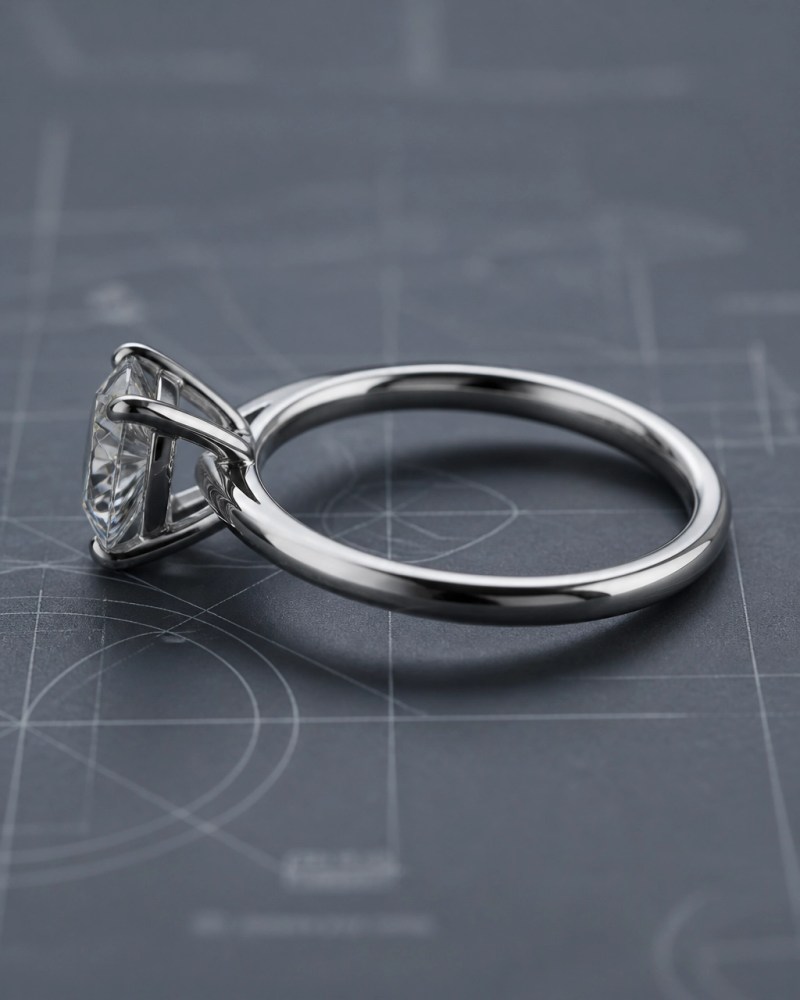
You will want to review the ring from the top, side, and underside. Side views will reveal height. Underside views will reveal contact points, gallery structure, and cleaning access.
A 3D-printed sample will provide another level of confidence. You will be able to trial the shape and proportions on the finger before the final ring moves to casting.
5. Request technical views, not only beautiful views.
Photorealistic images will help you judge style. Technical views will help you judge construction.
Your review should include multiple angles:
- Top view.
- Side profile.
- Three-quarter view.
- Bottom view.
- Interior band view.
- Stone-setting close-up.
You will want to inspect band thickness, prong placement, shoulder transitions, and the ring’s overall height.
A polished render may hide details. A technical view will expose them.
At Digital Jewelry Design, every design service and membership tier will include 2 to 4 high-resolution photorealistic images and 1 turntable animation video. The turntable will let you review the design from multiple angles before approval.
This will make feedback more specific. It will also make the design review easier to share with a partner, family member, or casting shop.
6. Use revisions to improve the design.
The first version will establish direction. The revision stage will establish precision.
You may want to adjust:
- Band width.
- Setting height.
- Prong shape.
- Halo size.
- Shoulder curvature.
- Stone spacing.
- Interior comfort.
- Decorative details.
Your feedback will be most useful when it will be specific.
Instead of saying, “It feels wrong,” you will be able to say:
- “The band will need to look 0.5 mm narrower.”
- “The center stone will need more visual height.”
- “The prongs will need to appear more delicate.”
- “The profile will need to sit lower.”
- “The underside will need a smoother transition.”
Every Digital Jewelry Design service and membership tier will include unlimited revisions. You will have room to refine the design until the concept and technical model will align.
7. Build the budget around the whole project.
Your budget will include more than the digital design.
You will want to identify which items will be included in your quote:
- Custom design work.
- CAD jewelry design services.
- Stone sourcing or stone cost.
- Metal cost.
- Casting.
- Setting labor.
- Polishing and finishing.
- Engraving.
- Shipping.
- Resizing.
- Appraisal or certification.
The complexity of the model will also affect production. Pavé settings, intricate galleries, unusual profiles, and delicate details may require additional technical review.
A clear budget will help the designer make practical decisions early. It will also prevent unnecessary redesign.
Digital Jewelry Design will focus on the digital design stage and the production-ready file. Your casting shop will determine its own requirements and production pricing. You will want to confirm those requirements before final approval.
8. Allow time for design, review, and production.
A custom engagement ring will require more time than a ready-made ring.
Your schedule will need to include:
- Initial concept development.
- Stone and measurement confirmation.
- CAD modeling.
- Photorealistic preview creation.
- Revisions.
- 3D print preparation.
- Fit validation.
- Final STL preparation.
- Casting and finishing.
Digital design turnaround may be short, but the complete jewelry production timeline will depend on the design’s complexity, the casting shop, stone availability, and finishing requirements.
You will want to begin before your proposal date. Starting early will create room for decisions, revisions, shipping, and unexpected production delays.
Plan first. Review early. Approve carefully.
9. Ask which files you will receive.
The final file will be one of the most important deliverables in a digital jewelry project.
You will want to know:
- Which file format will be delivered.
- Whether the STL will be production-ready.
- Whether the file will be optimized for jewelry 3D printing.
- Whether the casting shop will accept the file.
- Whether the design will include separate components.
- Whether changes after final approval will require a new file.
Digital Jewelry Design will provide the final STL file for the casting shop. The company FAQ confirms that STL files will be optimized for 3D printing in jewelry production. You will be able to share the file with your chosen casting provider, subject to that provider’s technical requirements.
The Digital Jewelry Design FAQ will provide additional information about file formats, production readiness, custom design, and casting support.
Keep your final files in a secure location. You will want them available for future production, resizing discussions, or documentation.
10. Compare the Design Club membership tiers.
If you will need ongoing digital jewelry design support, a membership may be the right structure.
The Design Club will include four membership tiers:
- Copper
- Silver
- Gold
- Platinum
You will be able to compare the available options through the Membership Comparison page.
Every design service and every membership tier will include:
- 2 to 4 high-resolution photorealistic images
- 1 turntable animation video
- Unlimited revisions
- 1 sample 3D print for trial on
- The final STL file for the casting shop
These inclusions will help you move from an idea to a validated production file without losing visibility during the process.
You will also be able to start with our first-design-free offer. This will give you a low-barrier way to experience the workflow before committing to a larger project.
Start your custom engagement ring design. Start your first design free.
Your ring will begin with a conversation. It will develop through precision CAD. It will become visible through photorealistic previews. It will be tested through a 3D-printed sample. It will finish as an STL file ready for your casting shop.
If you are looking for custom jewelry design, bespoke jewelry design, 3D jewelry modeling, or professional digital jewelry design, Digital Jewelry Design will help you move forward with clarity.
Start your first design free. Or contact Digital Jewelry Design to discuss your concept.
The Art of Precision.
Website under development
Digital Jewelry Design will be launching soon. For questions, contact support@digitaljewelrydesign.com, text 6029217150, or reach out through Facebook.
3 Responses