
A successful custom engagement ring design will start with the stone.
Not the ring size. Not the shank profile. Not a generic “one-carat” setting.
The actual diamond will determine the proportions, seat, prongs, gallery, basket, and final setting height. This stone-first workflow will help create a design that fits the gemstone before the piece reaches the casting stage.
For Digital Jewelry Design, stone-first modeling will combine modern 3D jewelry modeling with practical bench knowledge. The result will be a custom jewelry design that looks right on screen and works in production.
Measure First. Model Second.
Carat weight will not tell you enough to build a secure setting.
Carat will describe weight. It will not define the stone’s exact face-up size or profile. Two diamonds with the same carat weight can have different:
- Length and width
- Diameter
- Depth
- Girdle thickness
- Crown and pavilion proportions
- Table size
- Overall shape
A deep-cut diamond may weigh the same as a shallower diamond while appearing smaller from the top. Another stone may have a wider diameter but a thinner profile.
That difference will affect the entire design.
A setting modeled for a generic one-carat diamond may not fit the actual one-carat diamond you plan to use. The prongs may sit too far apart. The bezel may be too large. The gallery may not provide enough clearance. The stone may sit too high or too low.
Takeaway: Carat weight will be a reference. Millimeter measurements will control the design.
Get Accurate Measurements
The most reliable workflow will use the actual stone before final CAD approval.
For a round diamond, record:
- Girdle diameter
- Total depth
- Girdle thickness
- Table and crown information when available
For an oval, pear, marquise, emerald, radiant, or other fancy shape, record:
- Length
- Width
- Total depth
- Girdle thickness
- Point and corner conditions
- Symmetry and outline
You will have three practical options for collecting this information.
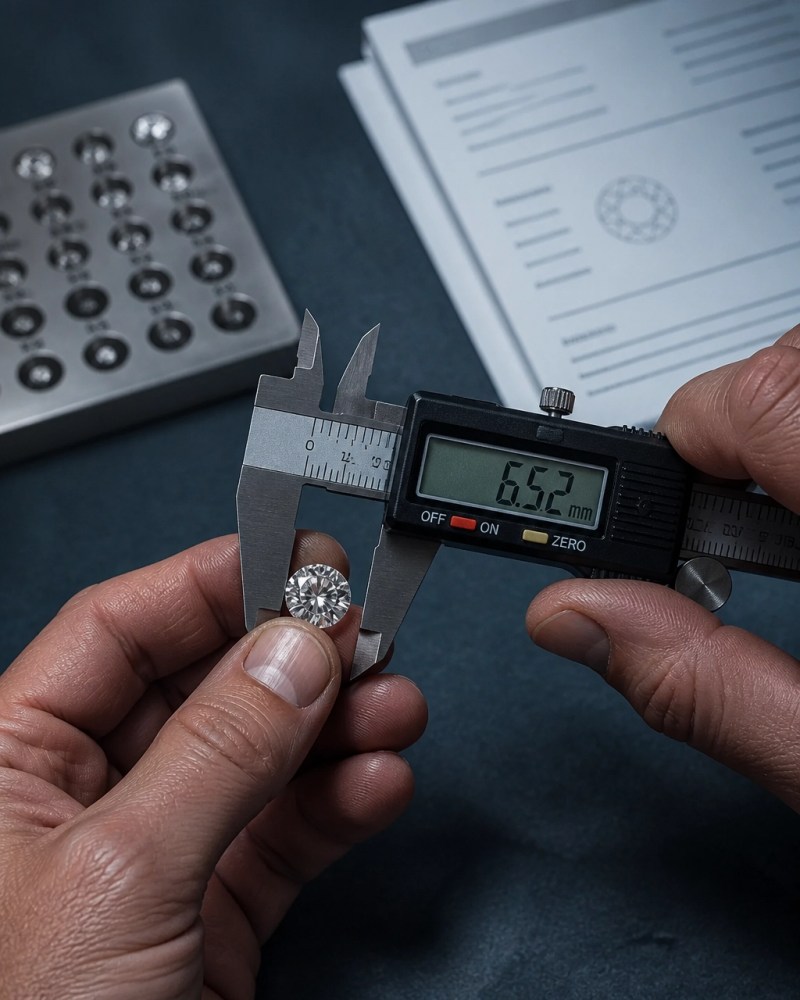
Use Digital Calipers
Digital calipers will provide length, width, and diameter measurements in millimeters. They will be useful when the stone is loose and accessible.
The stone will need to be held carefully. Do not squeeze the caliper jaws against the girdle. Excess pressure may chip a gemstone or produce an inaccurate reading.
Calipers will work best for overall dimensions. They will not always provide a complete picture of girdle thickness or irregular outlines.
Use a Stone Gauge
A stone gauge will help estimate diameter and compare the stone against standard sizes. It will be useful for round stones and quick bench checks.
A gauge will not replace careful measurement for a high-value custom piece. It will act as a practical verification tool.
Use the Seller’s Laboratory Report
A reputable laboratory report will usually provide the stone’s measurements and identifying details. The report may list length, width, depth, girdle description, shape, and cut information.
Send the report with the design request. If possible, provide clear photos of the stone and confirm that the report belongs to the exact stone being used.
Takeaway: The CAD file will be built from verified measurements, not an assumed stone size.
Shape First. Setting Second.
The stone’s shape and proportions will drive the setting architecture.
A round brilliant will require a different seat and prong layout than an oval. A pear-shaped diamond will require special attention at the point. An emerald-cut stone will need corner protection. A marquise will require secure support at both tips.
The stone will determine the metal around it.
Prongs
Prongs will be positioned around the stone’s actual outline. The number, location, thickness, and height will depend on the shape and girdle.
A prong that looks correctly positioned in a generic model may miss the girdle on the real stone. A prong that is too thin may not leave enough metal for setting and finishing. A prong that is too broad may cover more of the stone than intended.
The CAD model will need to show enough metal for the setter to form, polish, and secure the prongs after casting.
Bezel Height
A bezel will need to rise high enough to hold the stone securely without covering too much of its face.
The exact height will depend on the stone’s girdle and profile. A thicker girdle may require a different seat than a thin girdle. A deep stone may require more room below the girdle and may increase the total ring height.
The bezel will not be designed as a simple outline around the stone. It will be designed as a measured seat with a controlled wall profile.
Gallery and Basket
The gallery will support the center stone below the girdle. The basket will control the stone’s position, stability, and relationship to the band.
A deeper stone may require a taller basket. A shallow stone may allow a lower profile. A wide stone may require more lateral support. A pointed stone may require protective details at its tips.
These details will affect comfort, snag resistance, light access, and the overall appearance of the ring.

Proportions Will Protect the Design
Stone-first design will not mean making the setting as tight as possible.
It will mean allowing enough working room for:
- Casting
- Filing
- Polishing
- Stone setting
- Normal wear
- Future maintenance
The model will need to account for the practical difference between a digital surface and finished metal. A very thin CAD wall may become weaker after casting and cleanup. A sharp feature may soften during finishing. A delicate prong may not leave enough material for secure setting.
The stone’s depth will also influence the ring’s final height above the finger. A taller setting may create a dramatic profile, but it may catch on clothing or receive more impact during daily wear.
Modern custom engagement ring design will often favor lower, cleaner profiles. The final height will still need to respect the actual stone dimensions.
Takeaway: Good proportions will balance appearance, setting access, durability, and comfort.
Measure First. Cast Once.
The cost of rework will rise after casting.
If the stone does not fit the finished setting, the casting shop or bench jeweler may need to:
- Rebuild or replace the setting
- Recut the seat
- Reposition prongs
- Add or remove metal
- Alter the gallery
- Change the basket
- Recast the piece
- Refinish surrounding details
These changes may affect the finish, symmetry, timing, and budget.
Stone-first 3d jewelry modeling will move the critical fit decisions earlier in the process. The CAD model will provide an opportunity to review the stone position, setting height, prong placement, and band relationship before the model becomes a physical casting.
A sample 3D print will provide another checkpoint. The stone can be placed into the printed model to evaluate scale, finger clearance, setting height, and overall appearance.

Approve the Dimensions, Not Just the Render
A photorealistic render will show the design concept. It will not replace dimensional review.
Before casting, confirm:
- The stone measurements used in the CAD file
- The center stone’s position
- Prong or bezel placement
- Seat depth
- Gallery clearance
- Basket size
- Band width and thickness
- Final setting height
- Clearance from the finger and adjacent rings
- Required finishing allowance
This process will connect digital jewelry design to real bench work. It will also make communication easier between the client, designer, setter, and casting shop.
For more background, see our pages on the role of CAD in jewelry design, the benefits of 3D modeling, and the custom engagement ring design process.
Design Around the Stone
The stone will lead. The setting will follow.
That simple change will improve accuracy, reduce production risk, and create a better foundation for custom jewelry design. Whether you are using a family diamond, a newly purchased stone, or a retailer’s inventory, the actual dimensions will guide the final piece.
Digital Jewelry Design will provide custom CAD modeling for individuals, retailers, and jewelry businesses. Our US-based design approach will combine modern styling with practical production requirements.
A free first design will be available for qualified projects. Send the stone measurements, lab report, photos, and design direction. We will start with the details that matter.
Every design service and membership tier includes 2 to 4 high-resolution photorealistic images, 1 turntable animation video, unlimited revisions, 1 sample 3D print for trial on, and the final STL file for the casting shop.
Measure first. Model second. Cast with confidence.
The Art of Precision.
The Digital Jewelry Design website will remain under development as new services and resources are added.
For questions or project requests:
- Email: sales@digitaljewelrydesign.com
- Text: 6029217150
- Reach out through Facebook
Digital Jewelry Design : The Art of Precision.