
A clean cast starts with a controlled process. When that process fails, porosity can appear inside the metal or on its surface.
Porosity is one of the most important defects to identify before polishing, assembly, or stone setting. It can weaken a piece, create pits, and cause a finished design to fail later.
What Is Porosity?
Porosity is the presence of small holes or voids in cast metal. These voids may be visible on the surface, or they may remain hidden beneath the polished exterior.
Porosity matters because it can create:
- Weak spots in shanks, prongs, bezels, and structural areas
- Pits that become visible after polishing or finishing
- Areas that break during filing, soldering, or stone setting
- Potential stone-setting failure when a prong or seat lacks solid metal support
- Inconsistent surfaces that require rework or remanufacturing
Two common forms appear in jewelry casting:
- Gas porosity: Usually rounded or smooth cavities caused by trapped gas.
- Shrinkage porosity: Often irregular cavities caused when metal contracts during solidification and does not receive enough liquid metal to fill the space.
The first step is diagnosis. The second step is process control.
Check the Metal. Check the Flask.
Porosity rarely has one single cause. It usually develops from a combination of metal, mold, temperature, and flow problems.
Trapped Gas
Gas may remain dissolved in molten metal and come out as the metal cools. Air can also become trapped in the mold during filling.
Turbulent metal flow, poor venting, inadequate investment permeability, and insufficient vacuum can all increase the risk.
Gas porosity often appears as small, rounded holes. If you see scattered circular pits after polishing, investigate degassing, burnout, moisture, and flow.
Shrinkage During Solidification
Metal contracts as it changes from liquid to solid. If the design does not receive enough liquid metal during that transition, a void can form.
Shrinkage porosity often appears near:
- Thick sections
- Heavy design junctions
- Ring shoulders
- Prong bases
- Areas where a sprue is too small or poorly positioned
This is where sprue and tree design become critical. The casting must solidify in a controlled direction, with the sprue feeding the areas that remain liquid the longest.
Incorrect Metal Temperature
Metal that is too hot may absorb more gas and react more aggressively with the investment. Metal that is too cold may freeze before it fills thin details or feeds heavier sections.
The correct temperature will depend on the alloy, casting method, flask temperature, section thickness, and equipment. Avoid guessing. Follow the alloy supplier’s specifications and document reliable results for each process.
Dirty or Contaminated Metal
Investment powder, oxides, moisture, dirty scrap, and unknown alloy content can introduce gas or inclusions.
Use clean alloy and carefully inspect recycled metal before melting. Remove investment residue from reusable sprues and returns. Avoid repeatedly recycling castings that already show significant porosity.
Moisture in the Flask
Moisture creates steam and gas when molten metal enters the mold. Incomplete burnout can also leave wax, carbon, or other residues behind.
The result may be gas pockets, back-pressure, incomplete filling, or surface defects.
Investment mixing, drying, burnout, and flask preheating must be treated as one controlled system. Excess water in the investment mix and insufficient burnout both create avoidable risk.
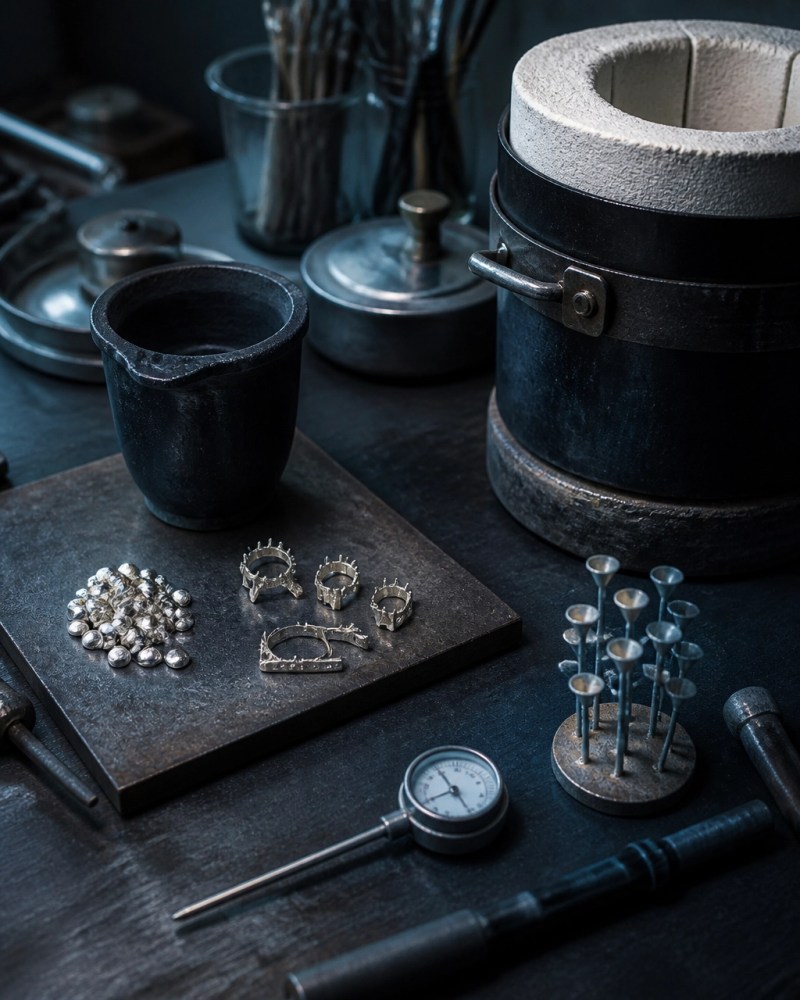
Control the Pour. Control the Result.
Use Proper Degassing
Degassing removes or reduces dissolved gas before the pour. The correct method will depend on the alloy and equipment.
Possible approaches include:
- Vacuum-assisted degassing
- Controlled inert-gas treatment
- Rotary degassing systems
- Proper flux use where appropriate
Degassing is not a substitute for clean alloy, correct temperature, or a dry flask. It must be part of the full casting process.
Use the Correct Pour Temperature
Do not hold molten metal at excessive temperature for longer than necessary. Overheating can increase gas absorption and investment reactions.
Do not pour too cold. Premature freezing can prevent complete filling and interrupt feeding.
Record:
- Alloy type
- Melt temperature
- Flask temperature
- Burnout schedule
- Casting method
- Observed result
This process log will help identify patterns instead of relying on guesswork.
Design the Sprue for Feeding
A sprue is not only a path for metal to enter the design. It is also a feeder.
A practical sprue design will:
- Connect to a substantial section of the design
- Support directional solidification
- Avoid thin bottlenecks that freeze too early
- Reduce sharp turns and turbulent flow
- Provide enough metal to feed shrinkage as the piece cools
The sprue should be planned during CAD jewelry design, not added as an afterthought. Digital models can be reviewed for wall thickness, heavy transitions, undercuts, and casting access before a pattern is printed.
Use Vacuum or Centrifugal Casting Correctly
Vacuum casting can help remove air from the mold and improve metal flow. It is especially useful when gas entrapment or mold back-pressure is suspected.
Centrifugal casting can help drive metal into fine details and support filling. However, excessive force or poor gating can create turbulence and pull air into the metal.
Neither method fixes poor process control. Vacuum level, flask condition, metal temperature, sprue design, and machine settings must work together.

Inspect Before Stone Setting
Do not send a questionable casting directly to the setter.
Before stone setting, inspect the piece under magnification. Look for:
- Pits near prongs and bezels
- Pinholes along the shank
- Open pores in polished areas
- Cracks near thick-to-thin transitions
- Soft or irregular edges
- Weak sections revealed during filing
A small surface pit may indicate a larger internal problem. Critical pieces may require additional inspection, including professional X-ray or computed tomography testing.
Stone setting adds force to the metal. The setter may cut seats, bend prongs, burnish edges, and apply pressure around the stone. Porosity in these areas can lead to broken prongs, loose stones, cracked bezels, or a failed setting.
Finding the defect before setting is less expensive and less disruptive than repairing a finished piece.

Design for a Better Casting
Porosity prevention begins before the model reaches the printer.
At Digital Jewelry Design, our US-based approach connects custom jewelry design, modern trends, and practical bench requirements. We do not treat CAD as a picture-only exercise. We consider wall thickness, stone-setting support, transitions, sprue access, finishing allowance, and production limitations.
Our manufacturing optimization service helps retailers and businesses prepare designs for more reliable production. Our quality-focused process supports both one-off custom work and jewelry design for retailers.
For designs that move from 3D printed jewelry to casting, early review can reduce avoidable defects and rework.
Every design service and membership tier includes:
- 2 to 4 high-resolution photorealistic images
- 1 turntable animation video
- Unlimited revisions
- 1 sample 3D print for trial on
- The final STL file for the casting shop
The Short Checklist
Before the pour:
- Use clean, verified alloy.
- Keep tools, crucibles, and flasks dry.
- Complete the recommended burnout cycle.
- Confirm metal and flask temperatures.
- Review sprue placement and feeding paths.
- Degas when required for the alloy.
- Set vacuum or centrifugal equipment correctly.
- Inspect the casting before polishing and stone setting.
Porosity is easier to prevent than to repair. Better digital preparation, better process control, and careful inspection will produce stronger, cleaner castings.
The Art of Precision.
Website Under Development
The Digital Jewelry Design website is under development. To discuss custom jewelry design, CAD jewelry design services, manufacturing optimization, or jewelry design for retailers, contact sales@digitaljewelrydesign.com or support@digitaljewelrydesign.com, text 6029217150, or reach out through Facebook.
For more information, visit digitaljewelrydesign.com.